Modeling Lake States Silviculture
Assisi 2026.4.4 applies the decision models of a silviculture guide to each stand as it develops through a long-term plan, beginning with the Wisconsin Silviculture Guide.
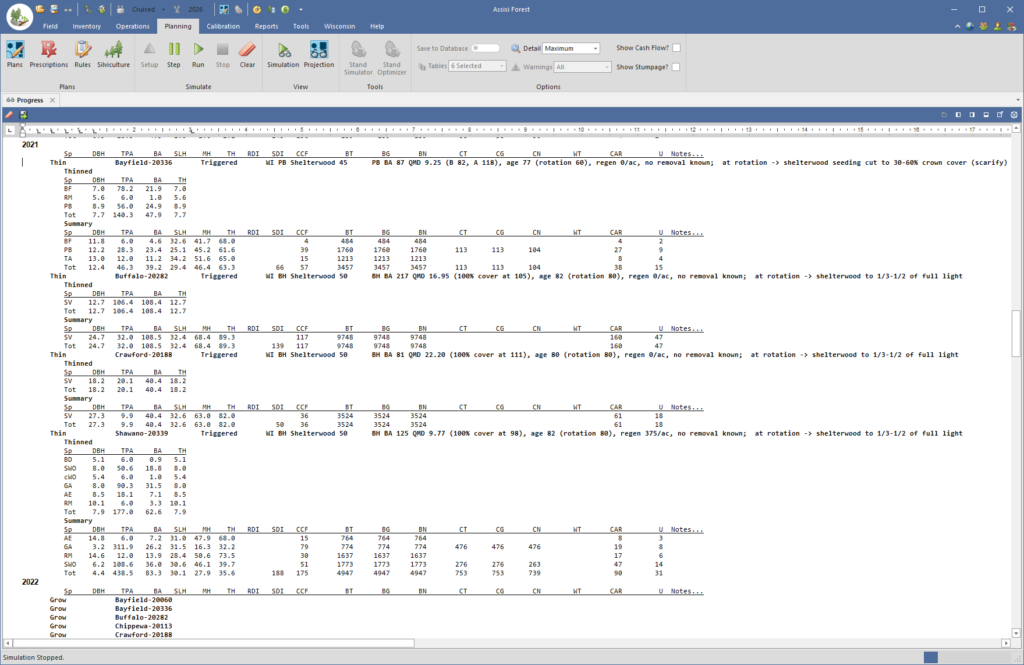
Implementation of silviculture decision models in Assisi 2026.4.4.
The Wisconsin Silviculture Guide defines silviculture as “the practice of controlling forest composition, structure, and growth to maintain and enhance the forest’s utility for any purpose” (Wisconsin DNR 2022). The practice is applied stand by stand: a stand’s cover type, site, stocking, age relative to rotation and established regeneration determine whether it is thinned, regenerated by a selection, shelterwood or clearcut method, or left untreated until a later entry. The Wisconsin guide, maintained by the Wisconsin Department of Natural Resources (DNR), presents for each major forest cover type in the state its silvical characteristics, the recommended silvicultural systems and methods, and the decision models that lead from stand condition to prescription.
Modeling silviculture means modeling the same prescriptions, repeatedly over a long planning horizon. Projected harvest volumes, their timing, and the composition of the forest at the end of the horizon all follow from the treatments assumed for each stand. A plan that assigns fixed treatments to fixed years cannot follow a silviculture guide because stands change over time. Conditions that justified a treatment when a plan was written do not persist. A long-term projection therefore has to reassess each stand’s prescription repeatedly as the stand develops.
Assisi Version 2026.4.4 carries out that reassessment during plan simulations. A silviculture model in Assisi is made of decision logic that assesses the condition of stands to decide on a prescription of treatments. The assessment and logic are carried out multiple times during a plan horizon so that changes in stand condition can be followed up with new treatments. These checks assess the stand’s cover type, species mix, regeneration, site potential, age and other conditions.
Representing Silviculture in Assisi
A silviculture model in Assisi has five parts.
- The Plan. A list of treatments to be carried out on stands, including a silviculture trigger that assesses stand state and adds further treatments. Plans are set up in the Plan Editor.
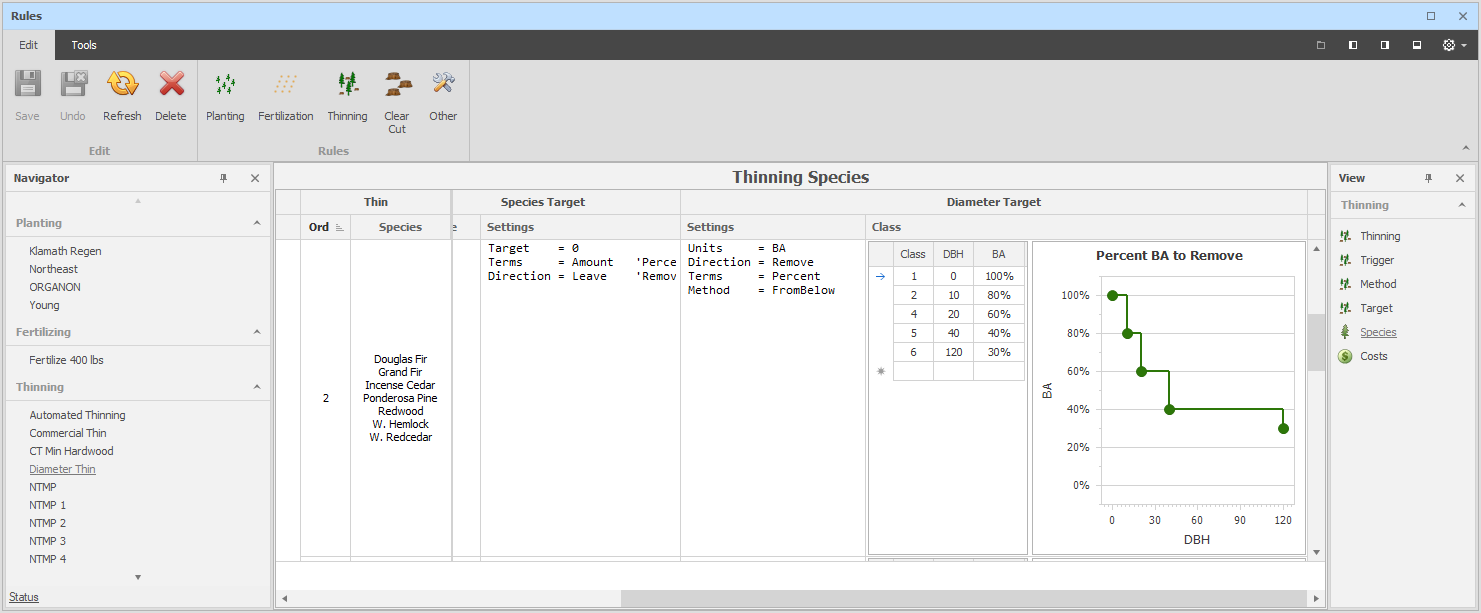
- Treatment Rules. How a treatment is carried out, for example thinning from above or below to a basal-area target by species or diameter class. Treatments are defined in the Rules Editor.
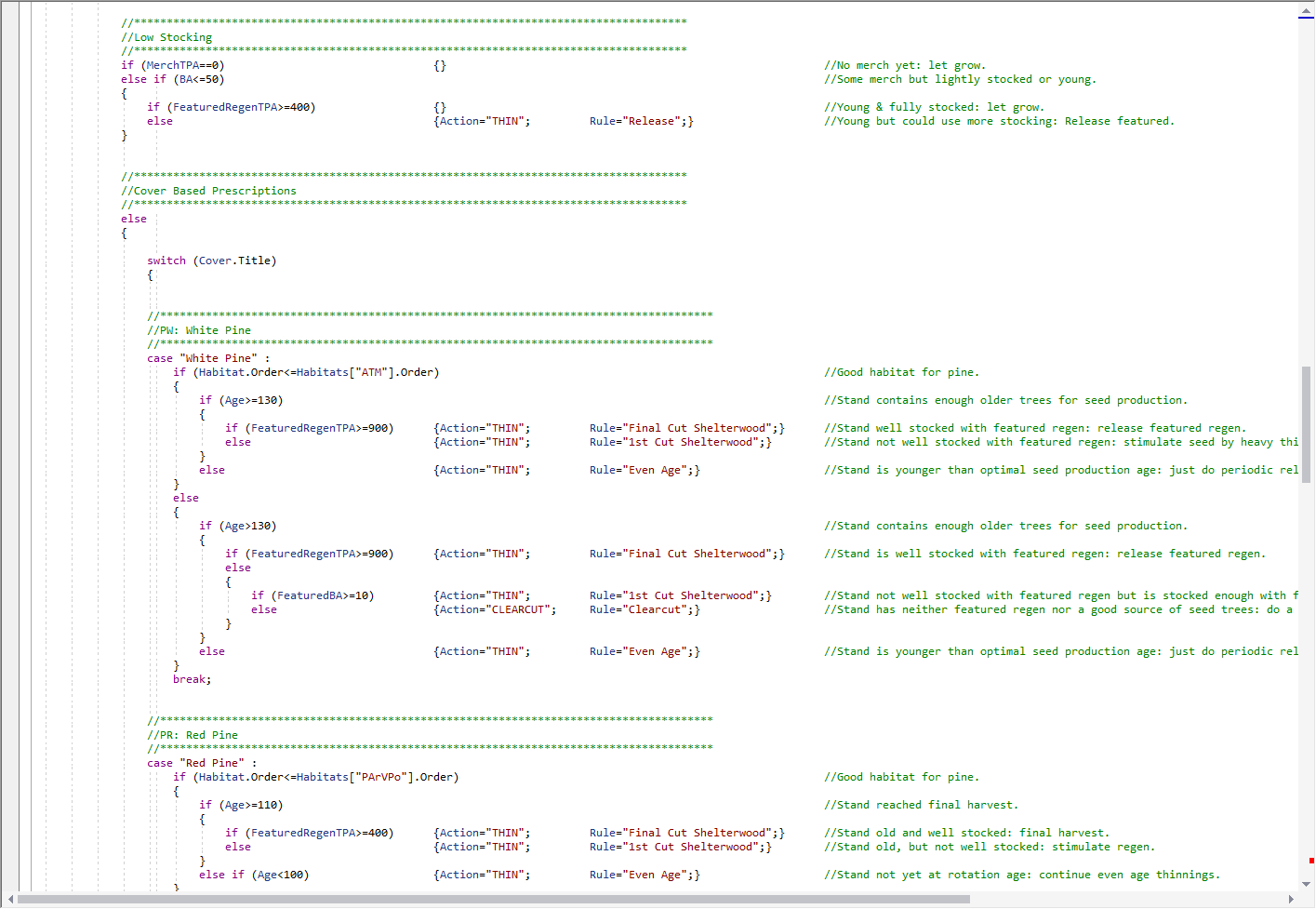
- Silviculture Triggers. The silviculture decision model. At each check a trigger follows a flowchart of decisions keyed on stand state and returns either a treatment or a deferral. Triggers are written as AddIns or as C# scripts.
- Stand State. Stand state includes silviculture defaults such as a target cover type and an even- or uneven-aged objective. The current cover type, habitat type, stocking, moisture class and any other stand-level condition can also be read by a silviculture trigger.
- Silviculture Definitions. The lists of cover types and habitat classes and the species that group within them, together with the guide’s own settings, such as rotation ages, cutting cycles and residual basal area targets, each with the page of the guide on which it appears.
The Plan
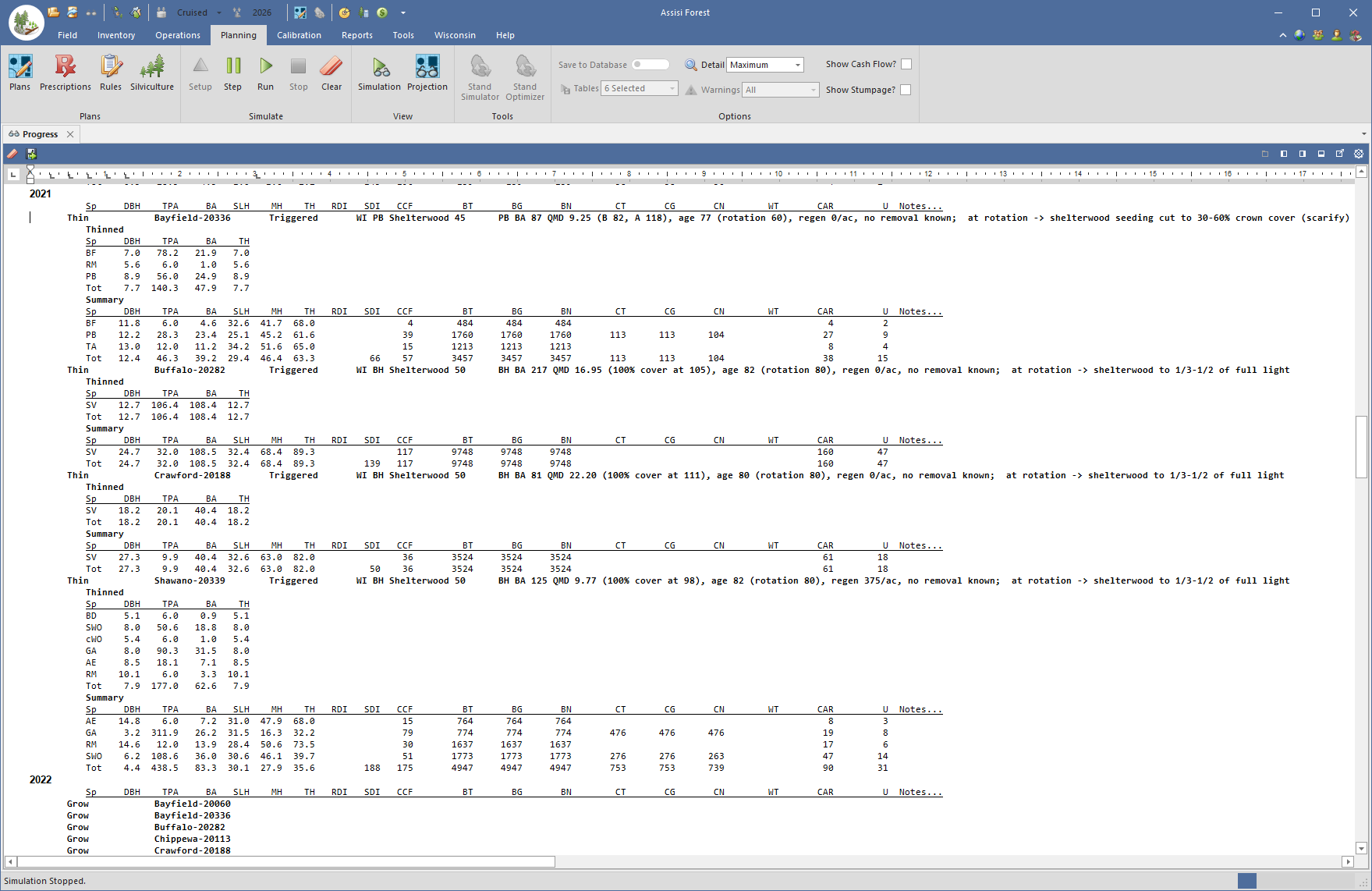
A plan assigns each stand its treatments over the planning horizon. A treatment can be scheduled for a fixed year, prescribed through a prescription, or decided by a trigger. In the Lake States plan each stand carries one Trigger action, the Lake States silviculture trigger, scheduled with a Begin year of 2026 and an End year of 2056. Between checks the plan simulation grows the stands with the calibration’s growth model, and each treatment that the trigger returns is added to the plan as an action.
Treatment Rules
A treatment rule specifies how a treatment is carried out, independently of when it is applied. A thinning rule, for example, sets the method (from below, from above, evenly, or to a BDq diameter distribution), the target, such as a residual basal area or a percentage of basal area removed, and the trees eligible by species and diameter class. The 30-year Lake States plan used 42 such rules for its cuts and plantings, each named by its cover type and treatment, such as Lake States NH Selection B75 D24 q1.3.
Silviculture Triggers
A silviculture trigger runs within Assisi’s plan simulation, so that the guide’s prescriptions are part of the long-term plan rather than a separate calculation. Each stand is re-examined at regular intervals, each prescribed treatment is written into the plan as an action, and the stand is grown on from its post-treatment condition. Each prescribed action carries a one-line statement of the stand condition and the reasoning for the action so that plan records include why each stand was treated and the guide’s prescriptions can be reviewed stand by stand.
Triggers are compiled as AddIns or C# script. Below is an example of a script-based trigger for Lake States pine.
Stand State
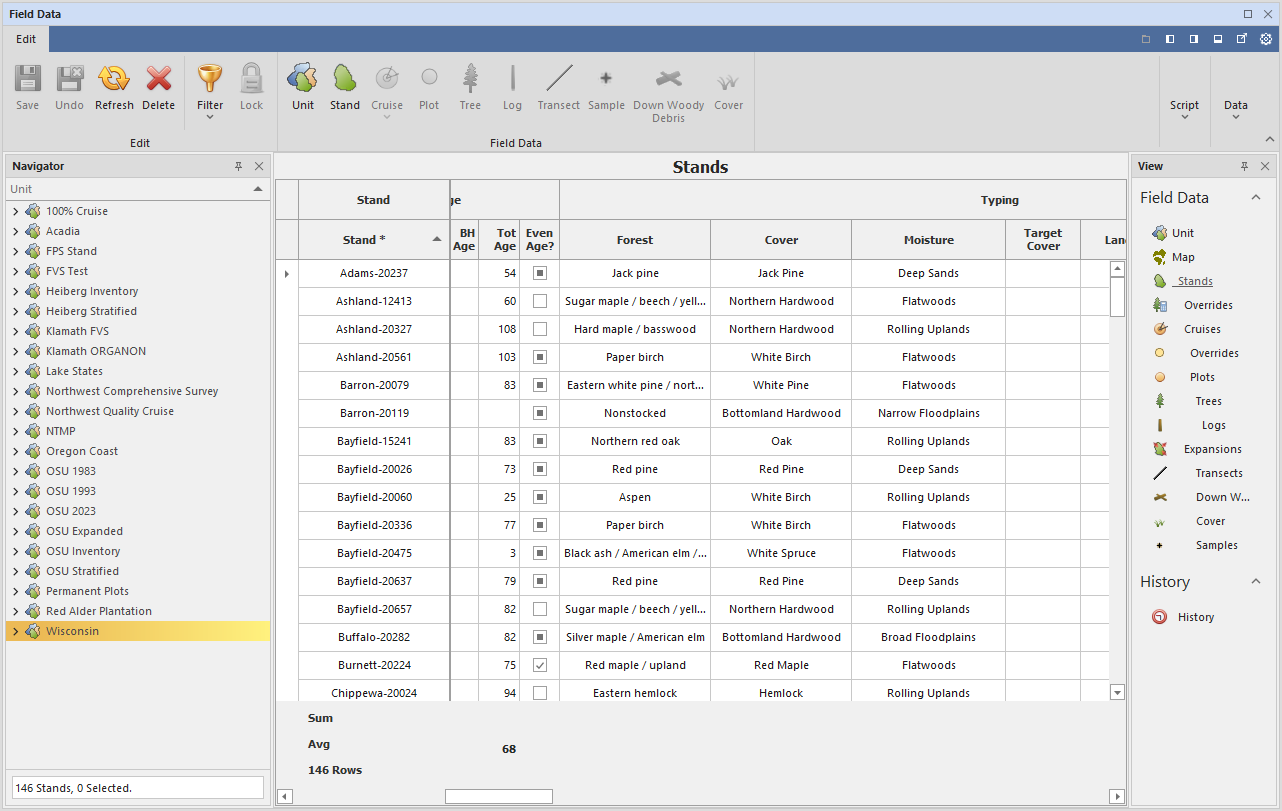
Stand state is what a trigger reads at each check. Part of it is recorded in Field Data and set by the forester: the silviculture that manages the stand, its habitat type, moisture class, target cover type and even- or uneven-aged objective. The rest describes the stand as it has grown and is recalculated at each check: the cover type, assigned from the current trees by the guide’s cover type definitions, together with basal area, quadratic mean diameter, age, established regeneration and stocking, which is calculated from the stocking method of each calibration species, including the tree-area-ratio equations of NED-2 (Twery et al. 2005).
Site and Kotar Habitat Types
In the Lake States, site is classified by the habitat type system of Kotar and colleagues (Kotar, Kovach and Burger 2002), in which each habitat type, such as AFAd, PArVAo or TMC, is assigned to a habitat type group. A stand’s habitat type is recorded with the stand, and the habitat classes map each habitat type to the groupings that the Wisconsin guide uses: the Kotar habitat type group, the oak site class, and the suitability of the site for a cover type. The decision models read those classes to make the prescriptions that depend on site. For example, the white pine rotation age is set by habitat type group, and an oak stand on a poor site is left untreated.
Silviculture Definitions
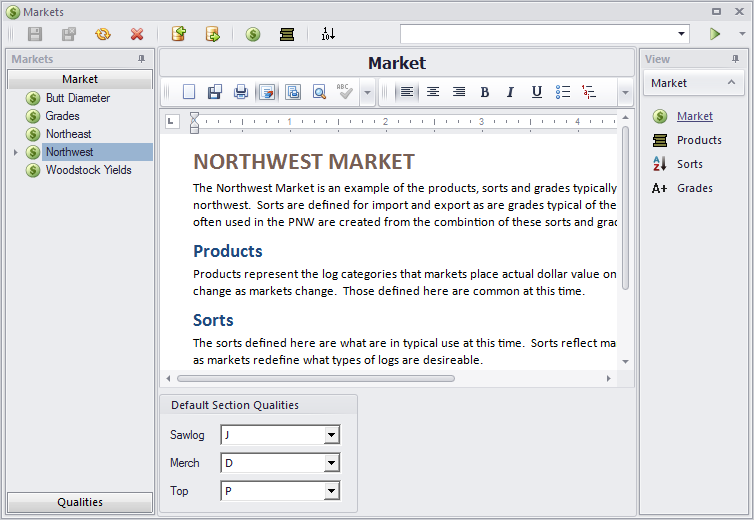
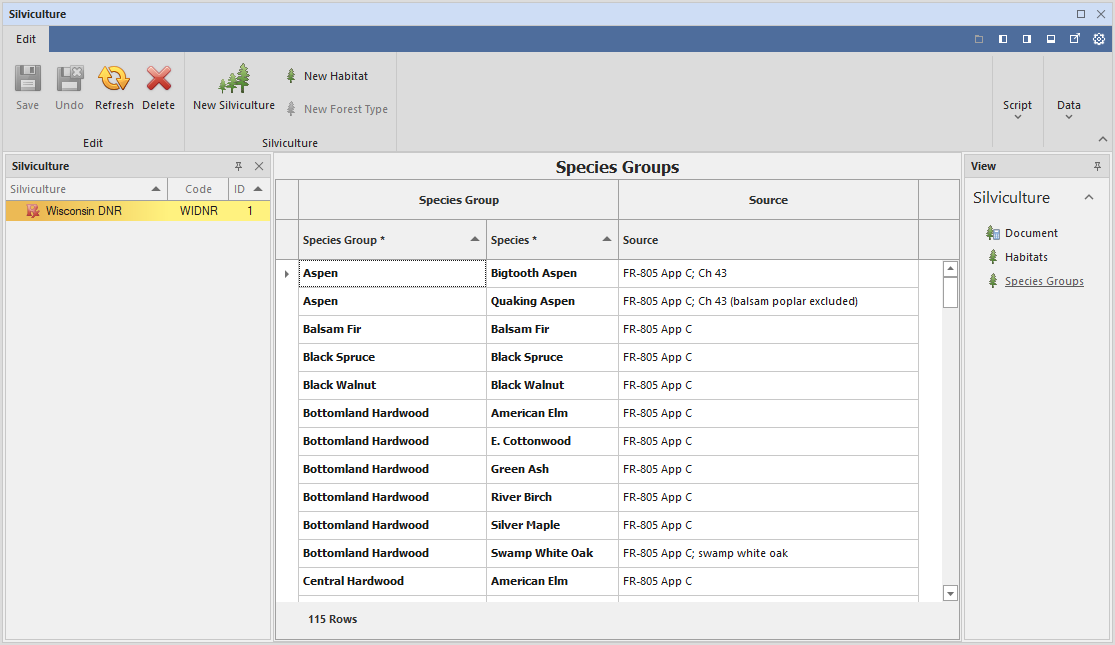
Silviculture definitions are the content of the guide held as data in the Silviculture Editor: its habitats and the habitat classes that group them, such as the Kotar habitat type group and the oak site class; its cover types and the species groups that define them, each row citing its source in the guide; and its numeric values, stored as settings with the page of the guide on which each appears. A database can hold several silvicultures, and each stand names the one that manages it.
The Wisconsin Silviculture Guide in Assisi
The first silviculture model implemented in full is that of the Wisconsin Silviculture Guide. The implementation covers all 18 cover-type chapters of the guide: Northern Hardwood, White Pine, Hemlock, Oak, Northern White Cedar, Red Maple, Aspen, Red Pine, Jack Pine, Tamarack, Fir-Spruce, Paper Birch, Black Spruce, Swamp Hardwood, Bottomland Hardwood, Central Hardwood, Black Walnut and Swamp Conifer. At each check the stand’s cover type is reassigned by the cover type definitions in the guide’s Appendix C. Those definitions assign the cover type from the stand’s species composition, by share of basal area in pole and sawtimber stands and by share of stems in seedling and sapling stands. The decision model of that cover type’s chapter then prescribes the treatment. The prescriptions include:
- Single-tree selection. In northern hardwoods, to a BDq residual structure (residual basal area 75 ft²/ac, maximum diameter 24 in., q 1.3), removing no more than one third of the basal area.
- Even-aged thinning. To the guide’s crown cover and stocking targets.
- Shelterwood. Seed cuts followed by overstory removal once regeneration is established.
- Clearcut and coppice. Clearcuts and coppice regeneration, with strip cuts where regeneration is limiting.
- Rotation and rehabilitation. Rotation ages by cover type and habitat type group, and rehabilitation or conversion of understocked stands.
- Deer winter shelter. Management of northern white cedar and other conifer stands for deer winter shelter.
Assigning Cover Type
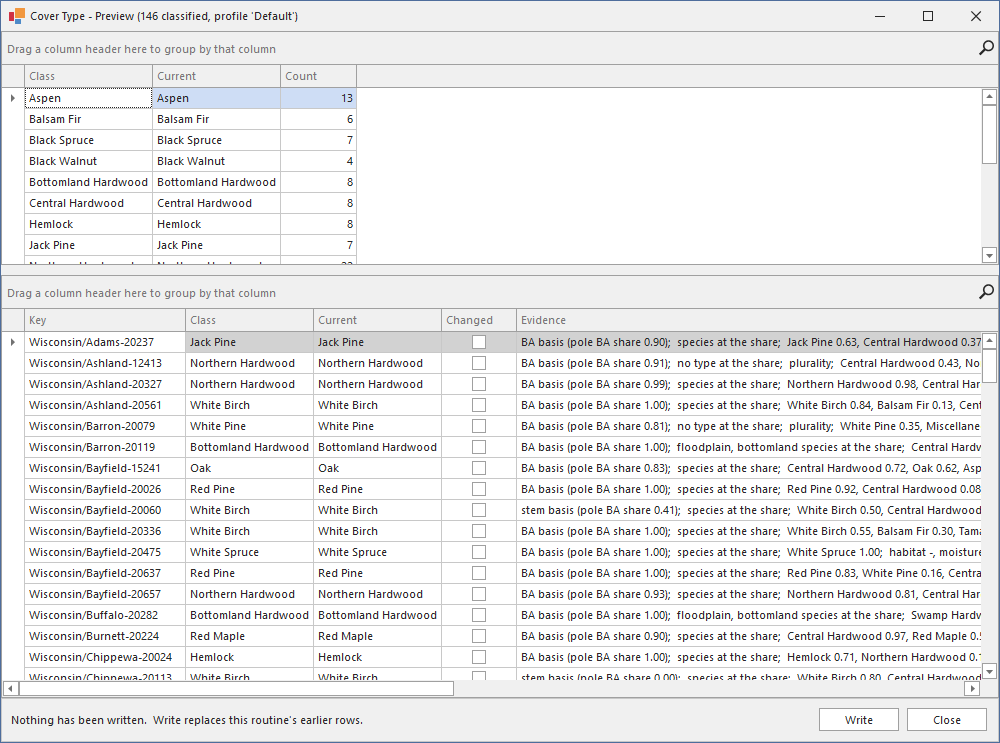
The cover type of each stand is reassigned at every check from the trees standing at that time, by the cover type definitions in the guide’s Appendix C. The starting inventory is typed the same way before a plan is run. The Cover Type tool on the Lake States tab applies the definitions to the selected stands and shows each stand’s proposed cover type, with the species shares on which it is based, before any value is written. A cover type entered by a forester is kept unless the tool is set to overwrite entered cover types.
The Silviculture Editor
The guide describes itself as “not a cookbook or manual, but rather a collection of silvicultural methods shown to be effective in achieving specific forest management outcomes,” and it leaves the forester the flexibility to adapt those methods to stand conditions and management objectives (Wisconsin DNR 2022). The implementation follows the same principle. Each numeric value taken from the guide is stored as a setting in the Silviculture Editor.
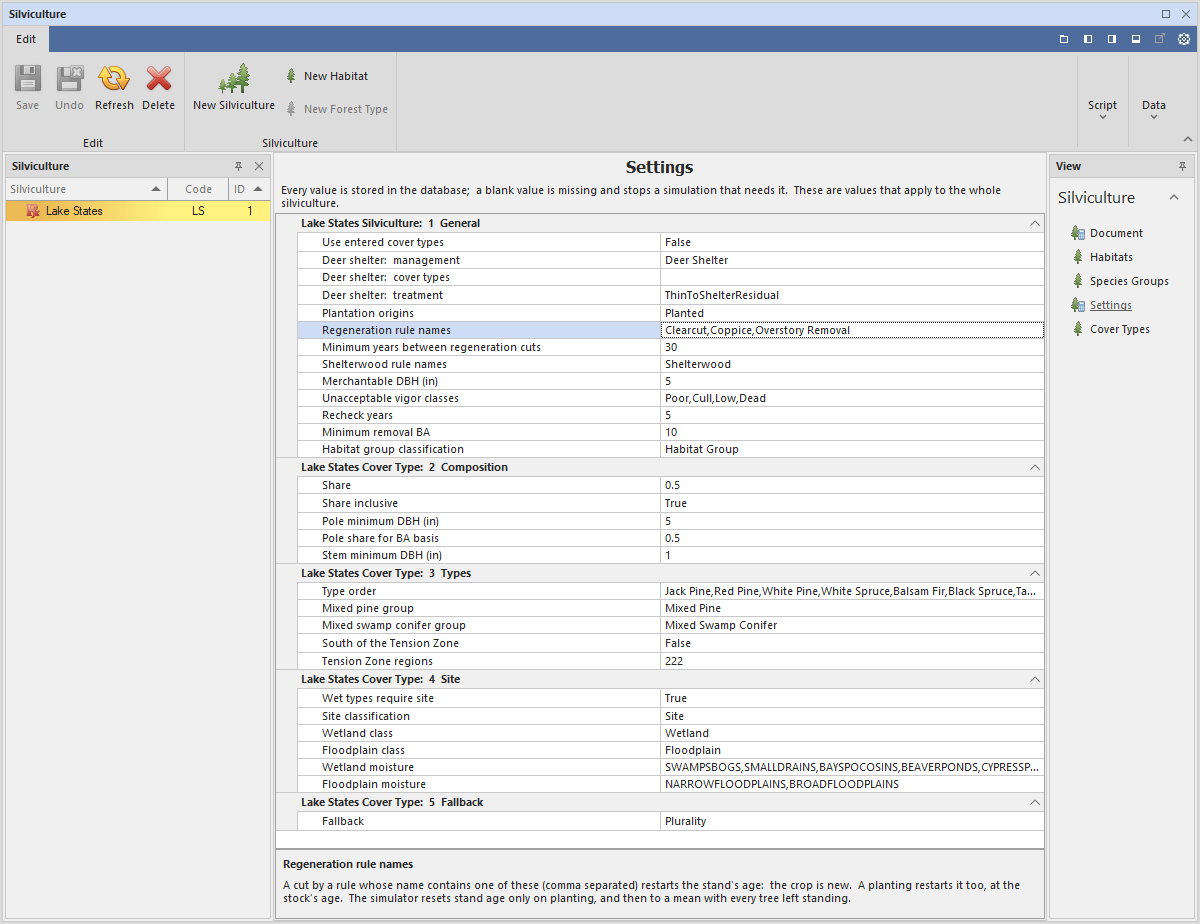
The Silviculture Editor organizes a silviculture into five views:
- Document. A Word document stored with the silviculture, for its description, sources and notes.
- Cover Types. The values of each cover type that the silviculture manages, such as its rotation ages, cutting cycles and the treatment rules its decision model names. A cover type’s values can be copied from another silviculture.
- Species Groups. The species groups that define each cover type, with each row citing its source in the guide.
- Habitats. The habitats of the guide, the forest types and species that each habitat supports, and its habitat classes, such as the Kotar habitat type group and the oak site class.
- Settings. The values that apply across cover types, listed by category, each with its description and the page of the guide on which it appears. A value that the guide does not state had to be inferred, and its setting is marked as inferred.
Local adjustments are made by changing the values of the silviculture model, not the program. A new model is created by copying an existing one, changing its values, and pointing stands to the new copy.
Other Silviculture Models
The Wisconsin Silviculture Guide is the first guide implemented as a silviculture model, although the components of a silviculture model are general. Silviculture definitions, habitat classes, stocking methods and triggers are not specific to Wisconsin, and a trigger is written in C#, so that a silviculture model can also represent another state’s guide, a landowner’s silvicultural standards or a research prescription. The Lake States implementation is an Assisi AddIn and, like all AddIns, is part of Assisi Enterprise.
Example Lake States Silviculture
Below is an example of running the Lake States silviculture model. The stands are from a set of Forest Inventory and Analysis (FIA) plots so that each cover type in the guide is represented. The “Lake States” plan applies the Wisconsin DNR thinning rules and the silviculture trigger to those stands for 30 years. Because FIA plots do not record a habitat type, the example uses each stand’s moisture class and region in place of the Kotar habitat type group.
Initial Run
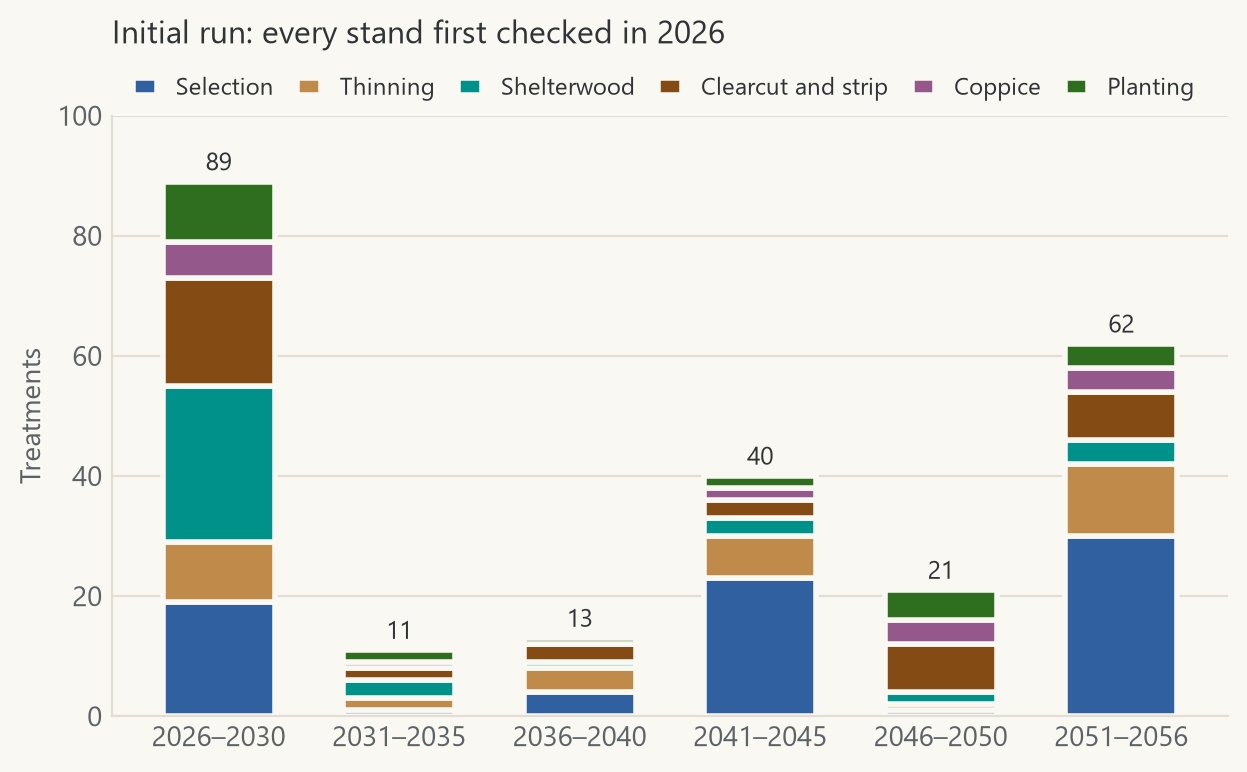
A first 30-year simulation applies the plan to the 146 stands as they were inventoried, with the trigger on every stand opening in 2026. The 146 stands (1,460 acres) received 212 cuts and 24 plantings between 2026 and 2056, and 79 of the cuts fell in 2026. These stands have no recorded management history, so many begin beyond rotation age or above their stocking targets, and the guide prescribes treatment for all of them at the first check. The cuts then recur in pulses as the cutting cycles of the stands treated in 2026 return, with 37 cuts in 2041 and again in 2056.
Rebalance
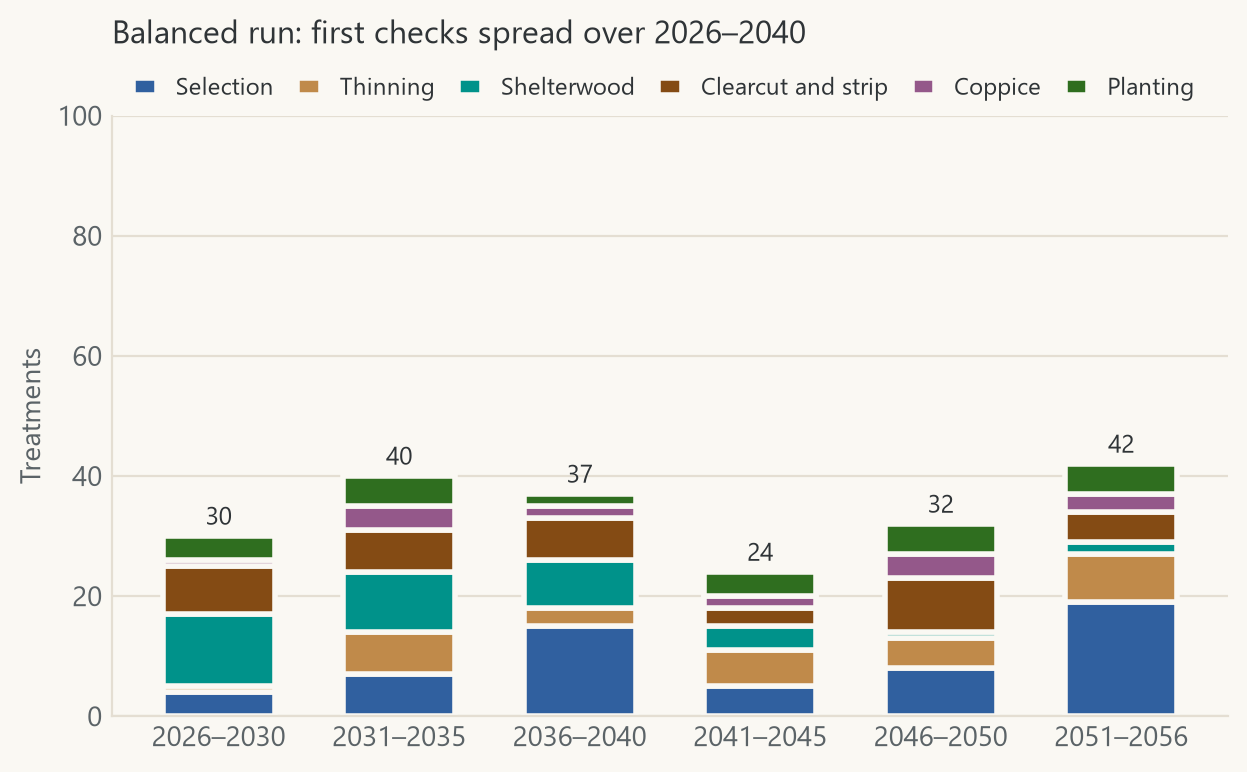
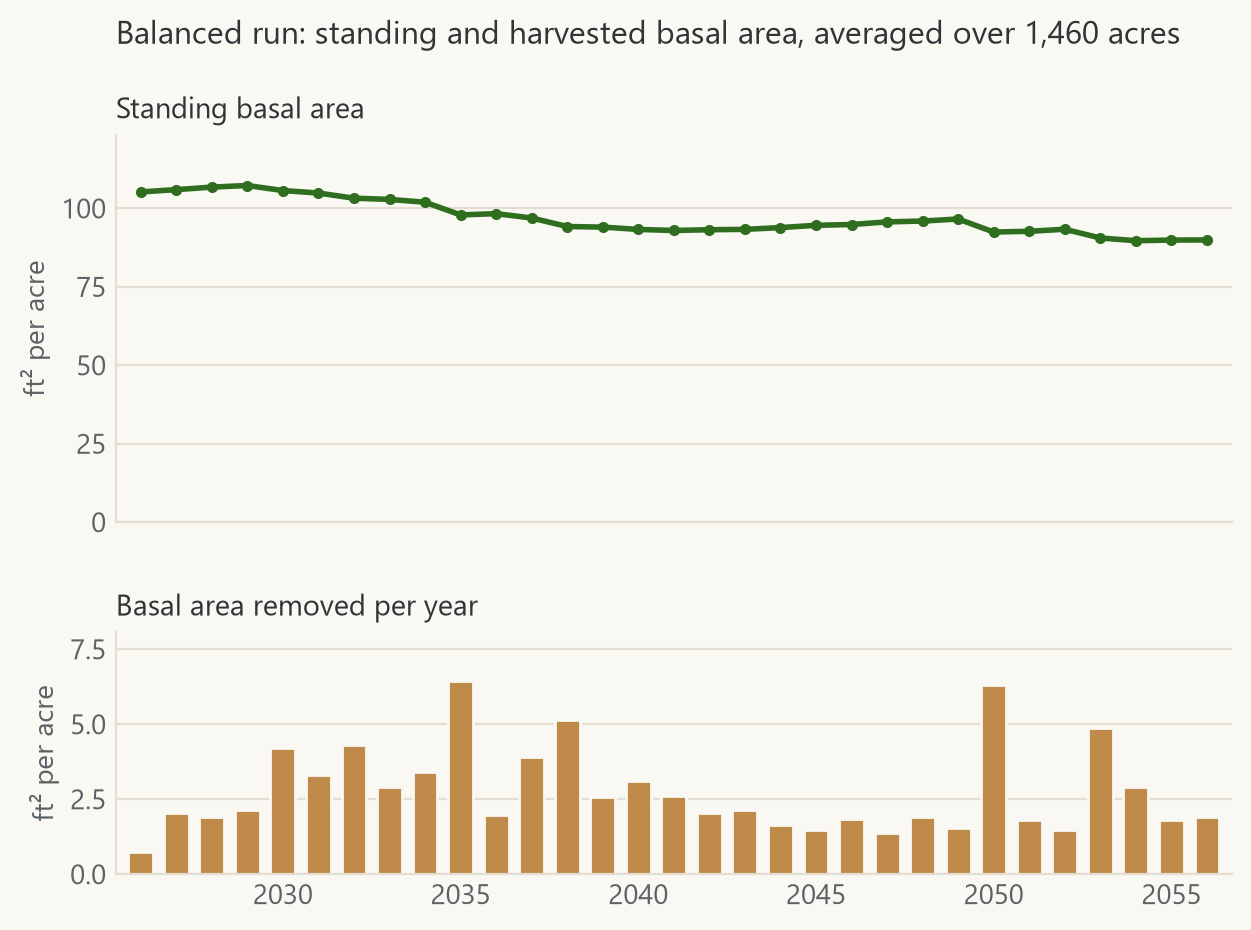
The concentration of cuts in 2026 reflects the plan rather than the forest. A forest under continuous management does not have all of its stands due for treatment in one year, although the actual entry history of these stands is unknown. That uncertainty is represented in the plan. In a second run the Begin year of each stand’s trigger was spread evenly over the first 15 years, 2026 to 2040, with nine or ten stands in each year, and the guide’s settings were left unchanged. In this balanced run the number of cuts per year ranges from 2 to 10, and no year removes more than 6.5 ft² of basal area per acre, compared with 35.1 ft² per acre in 2026 in the first run. Where spreading the first entries is not sufficient, the settings of the silviculture model, such as cutting cycles and rotation ages, are adjusted in the Silviculture Editor, so that the plan represents the management that a forest has actually received.
Treatments
| Group | Method | Rules (treatments in the first run) |
|---|---|---|
| Selection | Uneven-aged regeneration method. Trees of all sizes are removed to a BDq residual structure, and regeneration is continuous. | NH Selection Remove 33; NH Selection B75 D24 q1.3; SH Selection 80; HM Selection B130 D30 q1.3 (78) |
| Thinning | Intermediate treatment in even-aged stands. Stocking is reduced to a basal-area or crown-cover target to concentrate growth on the residual trees. | RP Thin 90 and 120; WP Thin B Q6–Q12; NH EA Thin 90 Q10–Q16; RM, FS, HM and RP Thin Remove 33–50; PB Thin B Q6; RM Thin 80 Q8 (36) |
| Shelterwood | Even-aged regeneration method in stages. A seed cut establishes regeneration under the residual overstory, and an overstory removal releases it. | OK, CH, BH, PB and FS Shelterwood; WP, FS and OK Overstory Removal (39) |
| Clearcut and strip | Even-aged regeneration method that removes the overstory in one cut or in a series of strips. | FS, JP, BS and WC Clearcut; RP Clearcut Reserve 5; TK, BS and WC Strip Series 33; BW Harvest 18 (42) |
| Coppice | Clearcut that regenerates the stand from stump sprouts and root suckers. | AS and RM Coppice Clearcut (17) |
| Planting | Planting after a regeneration harvest where the guide calls for it. | FS Plant White Spruce 800; WP Plant 900; BW Plant 50; RP Plant 800 (24) |
Projections
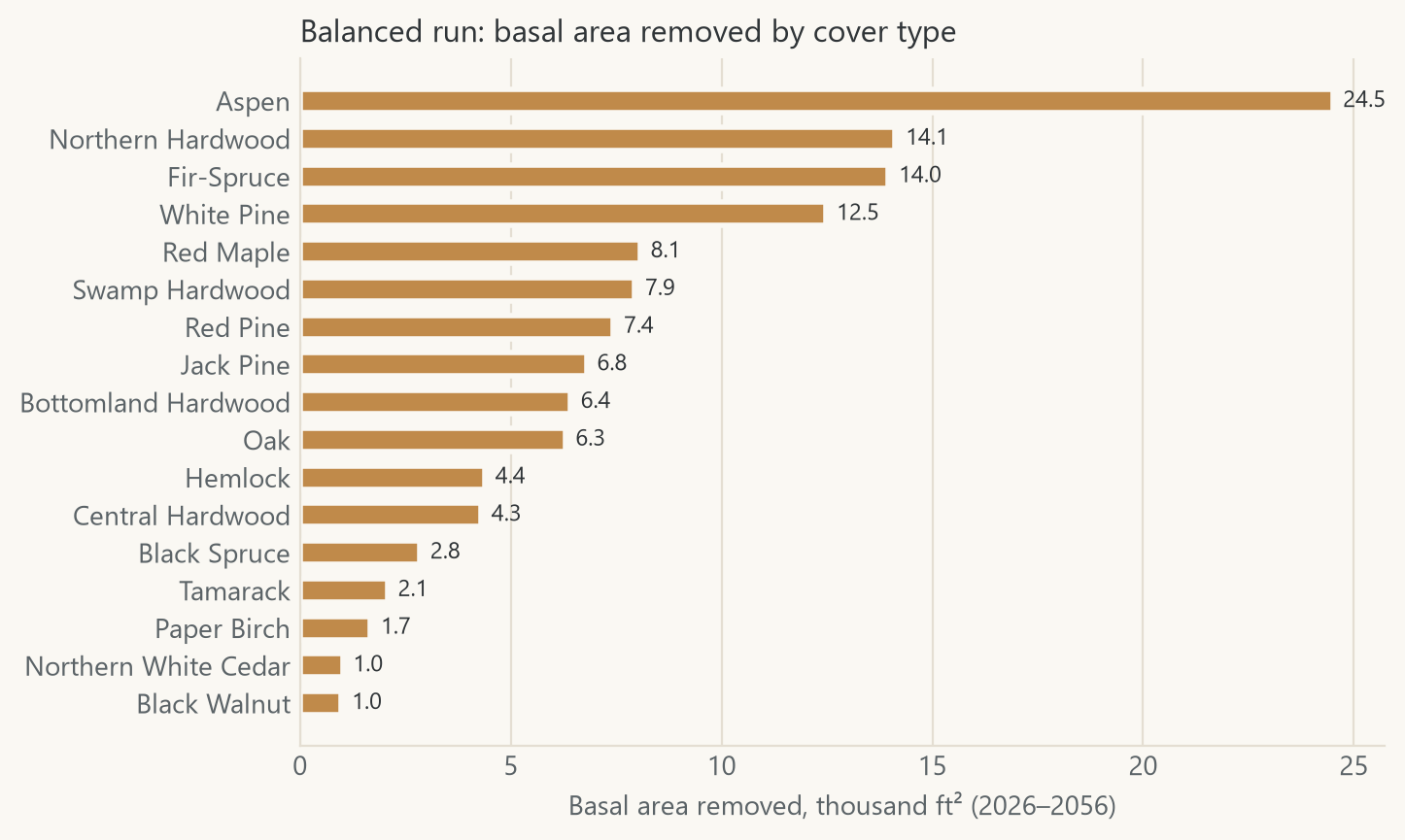
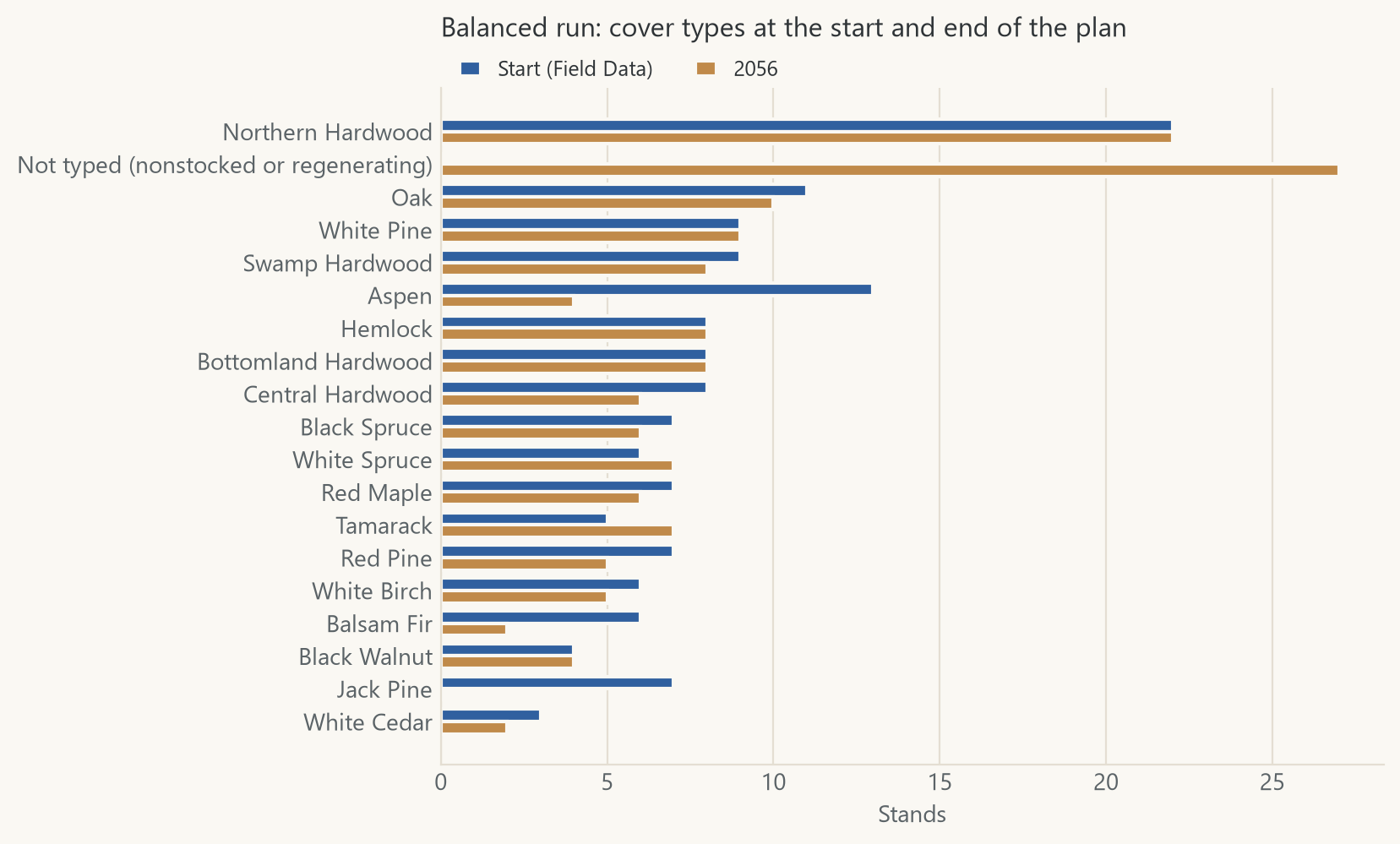
The remaining figures are from the balanced run. Over the 30 years it prescribed 180 cuts and 25 plantings and removed 85.8 ft² of basal area per acre, while standing basal area fell from 105 to 90 ft² per acre as the stands that began above their stocking targets were thinned toward them.
References
Kotar, J., J.A. Kovach, and T.L. Burger. 2002. A Guide to Forest Communities and Habitat Types of Northern Wisconsin. 2nd ed. Madison, WI: University of Wisconsin–Madison, Department of Forest Ecology and Management.
Twery, M.J., et al. 2005. NED-2: A decision support system for integrated forest ecosystem management. Computers and Electronics in Agriculture 49: 24–43.
Wisconsin Department of Natural Resources. 2022. Wisconsin Silviculture Guide (FR-805). Foreword: Application of Guide, dated February 22, 2022. Madison, WI: Wisconsin DNR.